
How to play Frostrail
The loop that every upgrade, Relic, and crew role is built around.
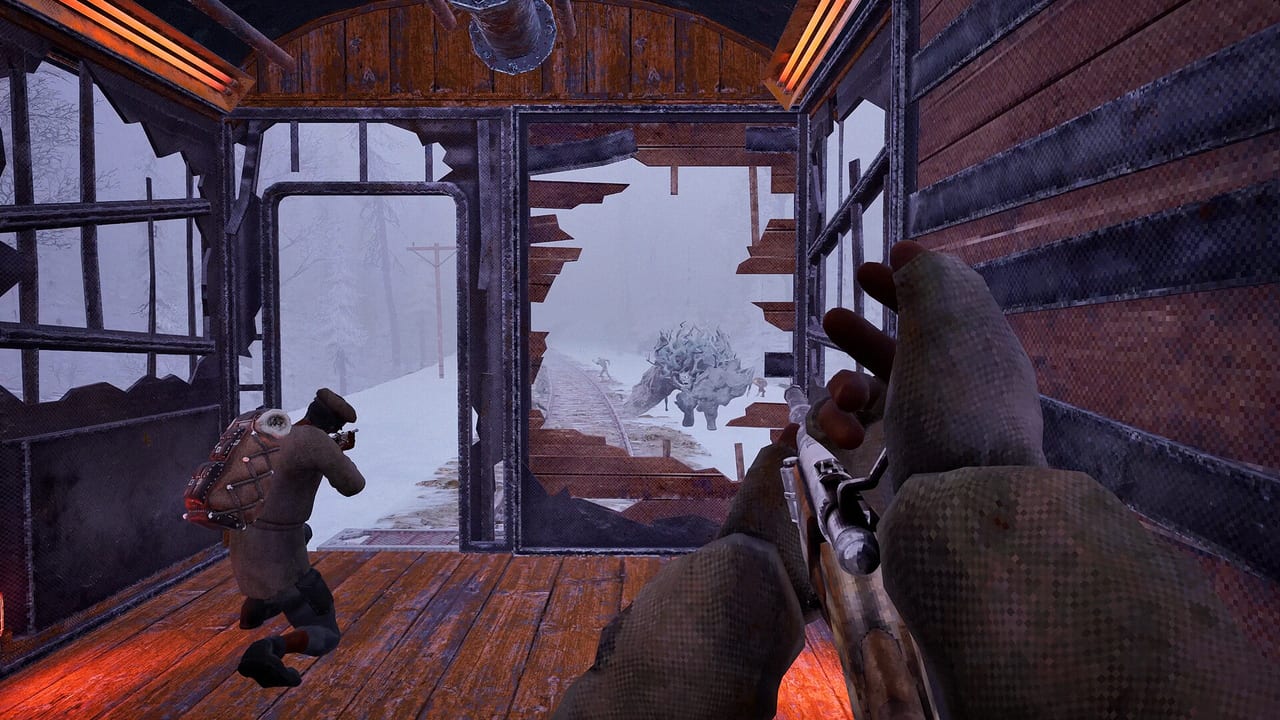
Frostrail looks like an open-world survival shooter in the trailers. In practice the rails decide where you go, the Eden Engine decides how long you can stay, and the blizzard decides whether greed is a build or a wipe. This page is the loop: what a “level” is, what you do at a stop, how fights are supposed to feel, and how solo versus online co-op changes the same rules.
If you have not installed a test build yet, start on Getting Started instead.
The pilgrimage, not an open sandbox
FakeFish talks about a pilgrimage across a frozen empire. Playtests and 2026 notes describe levels with progression that carries between them and, later, multiple exit points. That is closer to a directed survival campaign than to a borderless loot desert.
Your job on each stretch of track:
- Keep the train able to move and stay warm.
- Stop where salvage is worth the heat you will spend.
- Enter ruins, bunkers, or dungeons only with a way home.
- Spend what you brought back on walls, stations, guns, clothes, and repair — not on a museum of broken parts.
- Push to an exit that actually advances the pilgrimage.
Multiple exits are a design confession: FakeFish expects you to skip a deathtrap. If a dungeon is loud and your ammo is a rumor, take the boring exit. The survival page exists for crews who cannot take that advice.
The stop loop in detail
Approach. The locomotive is a moving fortress and a dinner bell. Spring updates folded train-defense encounters into obstacle-clearing. Someone should be watching windows and the rear car while the engine person deals with the blockage. A whole crew piling out to “just check the snow” is how Revenants learn your floor plan.
Scavenge. Official copy names mining camps, villages, wreckage, and underground vaults. Heat is a timer. Clothing sets added in 2026 stretch that timer; they do not delete it. Grab fuel, repair materials, ammo, food, and Relics. Leave furniture. The checklist is the short version of this paragraph for a second monitor.
Dungeon. Modular dungeon art, better lighting, and Relics showed up in 2026 notes. Relics are found below and activated on the train for temporary buffs. That means a Relic in a backpack while the train is under attack is a wasted button. Rank and use-cases: Relics.
Exfil. The walk back is the actual boss. Blizzard slows and blinds. Engine noise pulls things out of the white. If two players are heavy on loot and nobody is holding a lane, you will drop the Relic in a drift and learn nothing except the temperature gauge.
Spend. Repair benches, crafting, weapon stations, extra carriages, storage. FakeFish’s own pitch is that the train must grow as the struggle grows. A stack of uncrafted guns is not power. See Train and Eden Engine and the weapon list.
Combat is supposed to hurt
Lead designer Ez Jämsen described a “guns first” game with WW1-esque archetypes: pistols, shotguns, rifles, machine guns, plus a handful of melee weapons. Guns are craftable and modular. Ammo is a luxury. That combination is the whole personality of a fight.
Two published enemy “factions”:
- Revenants — more zombified, mostly melee, larger numbers.
- Corrupted soldiers — ranged, a bit smarter, smaller groups.
Store-page mature notes also mention wolves and humanoids with blood. Eldritch shapes show up in trailers and in train-defense set pieces. Full pressure map: enemies.
Practical rules that survive patch notes:
- Do not dump a magazine into a melee swarm if a shotgun or a retreat to a doorway exists.
- Do not peek a soldier pair in a blizzard with a pistol you crafted “for the collection.”
- Do not start a dungeon fight you cannot finish with the ammo in your current mag plus one spare.
- Do use the train as a funnel. Playtest shots from inside a wrecked car, teammate on the left, snow-creatures on the rails, are the tutorial FakeFish forgot to print.
Solo versus a four-stack
Crews of 1–4, online co-op, no advertised split-screen. Solo is slower and stingier: you cannot clock the boiler and a cellar at once, so your stops should be smaller. Four people fail in the opposite way — everyone loots, nobody watches the engine, and the defense encounter becomes a wipe because the last person back is dragging a cupboard.
Roles are not classes. They are jobs you say out loud. The co-op page is the script. If you refuse to script, at least steal the checklist and tick “rear guard assigned” before the doors open.
What “winning” a session means before Early Access
There is no live endgame ladder. A good session is:
- The train still has heat and fuel.
- You spent salvage on something that will still matter on the next level.
- You left a dungeon on purpose.
- You sent FakeFish a bug or a survey note if a system felt broken — tests exist for that, see closed beta.
Full 1.0 scope is still a promise: more biomes, more loot, more train upgrades, about a year of Early Access. Track that on the roadmap, not in your current backpack.
When the loop is clear, specialize. Locomotive problems go to the train guide. Heat and repair go to survival. Input questions go to controls. Gun arguments go to the tier list.
Frequently Asked Questions
Quick answers to the most common questions.
Is Frostrail an open-world sandbox?
It is sold as an open-world survival FPS, but play is rail-directed: levels, exits, and a train you must keep alive. Treat stops as missions, not as a borderless loot desert.
Can I play the whole game solo?
Yes. FakeFish designed for crews of 1–4. Solo works; it is slower. Online co-op is the group mode, not a required gate.
Should I clear every dungeon?
No. 2026 notes added multiple exit points. Walk away when ammo, heat, or the train is the scarce resource. Relics are bait with a timer.
Where do I learn crew roles?
The co-op guide and the survival checklist. This page is the shared loop those roles plug into.